Andrzej Pokraka

Research

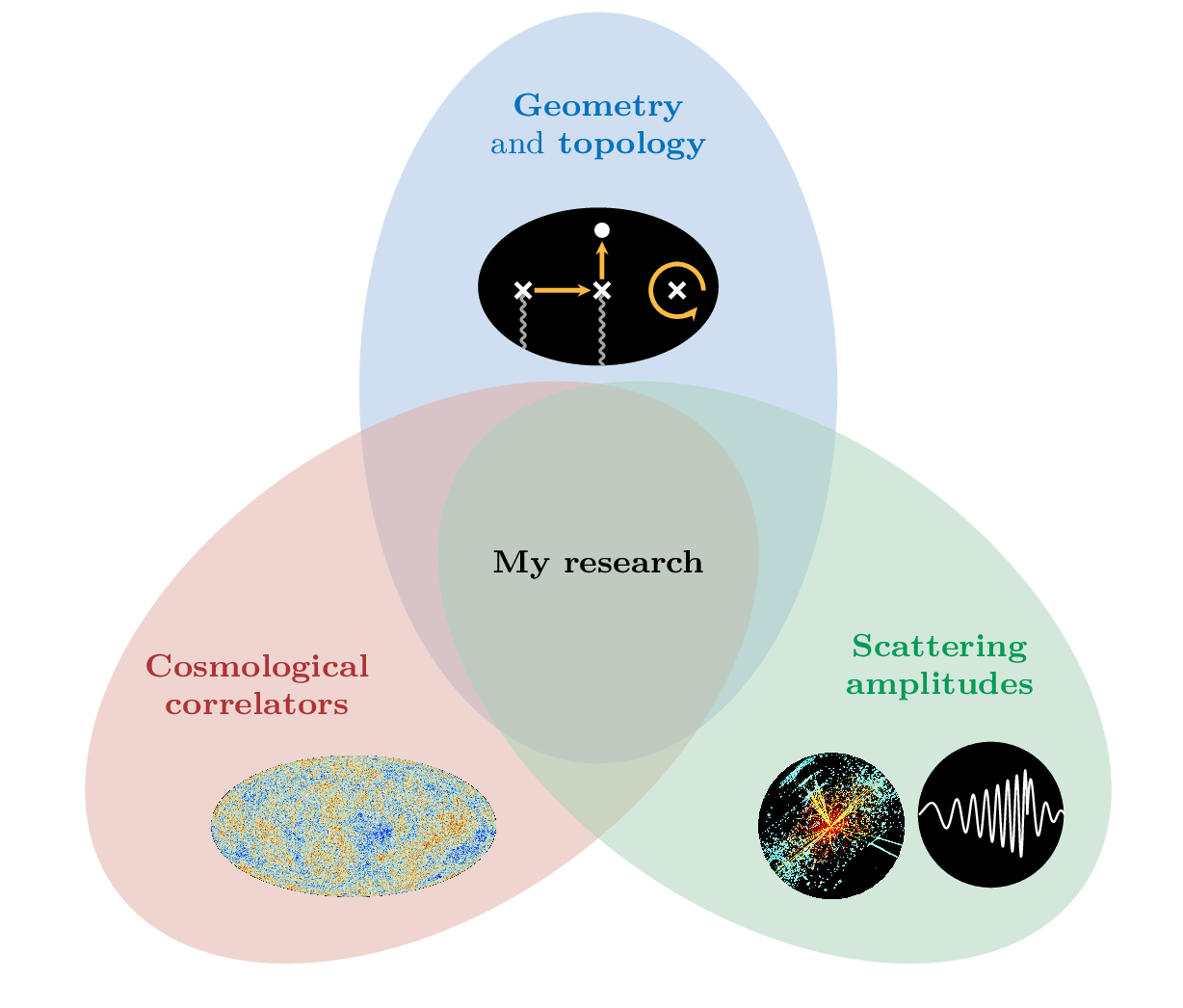
Venn diagram: geometry and topology, cosmological correlators and scattering amplitudes, with my research in the overlap

My work lies at the intersection of geometry, particle physics and cosmology. I build mathematical formalisms tailored to particle physics, to reveal the hidden simplicity of QFT observables and to create efficient algorithms for computing them. I do this by investigating scattering amplitudes and cosmological correlators—which connect theory to experiment, from particle collisions at the LHC to inflation and gravitational waves—through the lenses of algebraic, complex and positive geometry.

My main tool is twisted (co)homology, which I helped bring into physics (1910.11852), together with its partial/relative extension, which I introduced (2104.06898, 2112.00055). My work removes the spurious regulators needed to force QFT integrals—Feynman integrals, cosmological correlators and string integrals alike—into standard mathematical frameworks, which would otherwise increase the complexity of computations and obscure physical structure in intermediate steps. The same (co)homology underpins Feynman integrals, cosmological correlators in Friedmann–Robertson–Walker (FRW) spacetimes, string amplitudes, the double copy, energy correlators and more.

Three questions drive my research:

Feynman integrals from twisted (co)homology

With Simon Caron-Huot, I developed relative twisted (co)homology for Feynman integrals. Differential equations follow from this structure alone, and the intersection number, which generalizes generalized unitarity, can be used in place of integration by parts. With Sebastian Mizera, I showed that the differential equations are fixed exactly by the opposite limit ε → ∞, giving an algorithm for intersection numbers that works for any geometry.

Papers: 2104.06898 · 2112.00055 · 1910.11852 · 2605.29789
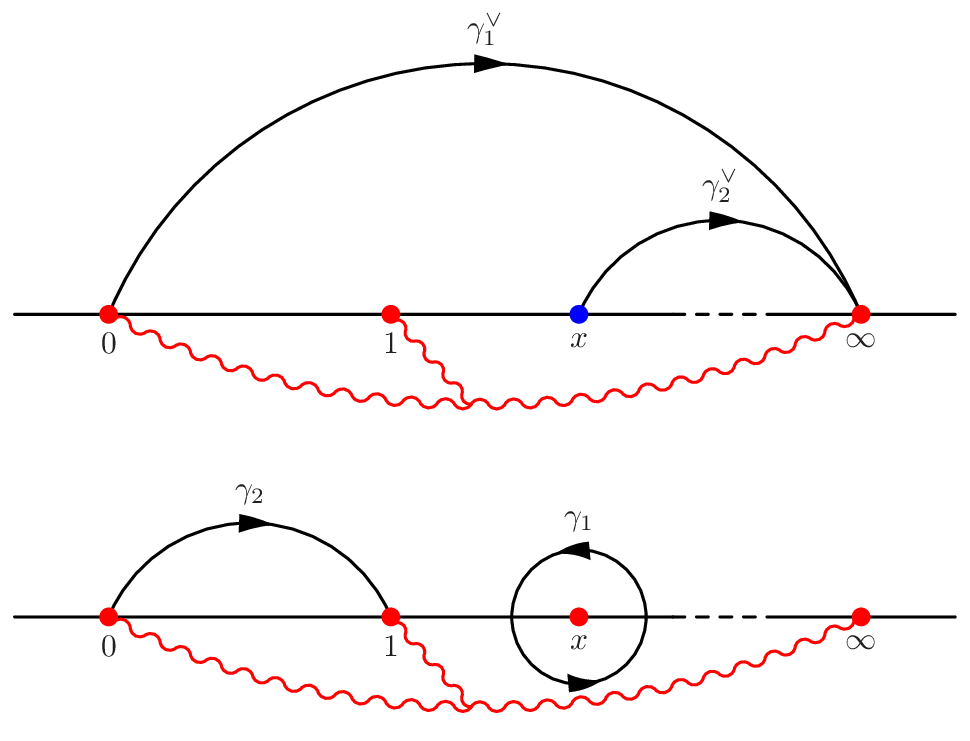
Dual cycles and cycles for the Gauss hypergeometric function on the punctured line, with branch cuts
The 2F1 example: dual cycles γ∨ (top), for which x is a boundary, and cycles γ (bottom), which encircle x; wavy lines are branch cuts (see 2112.00055).

Elliptic and higher-genus geometry

Beyond polylogarithms, integrals depend on elliptic curves and higher-genus surfaces. I extended relative twisted (co)homology to elliptic Feynman integrals, where the differential equations factorize loop by loop, and constructed canonical differential equations for the five-mass kite, the most general two-loop self-energy. The same tools give a double copy for Riemann–Wirtinger integrals, which share their function space with string amplitudes, at any genus.

Papers: 2210.09898 · 2401.14307 · 2312.02148 · 2509.01598

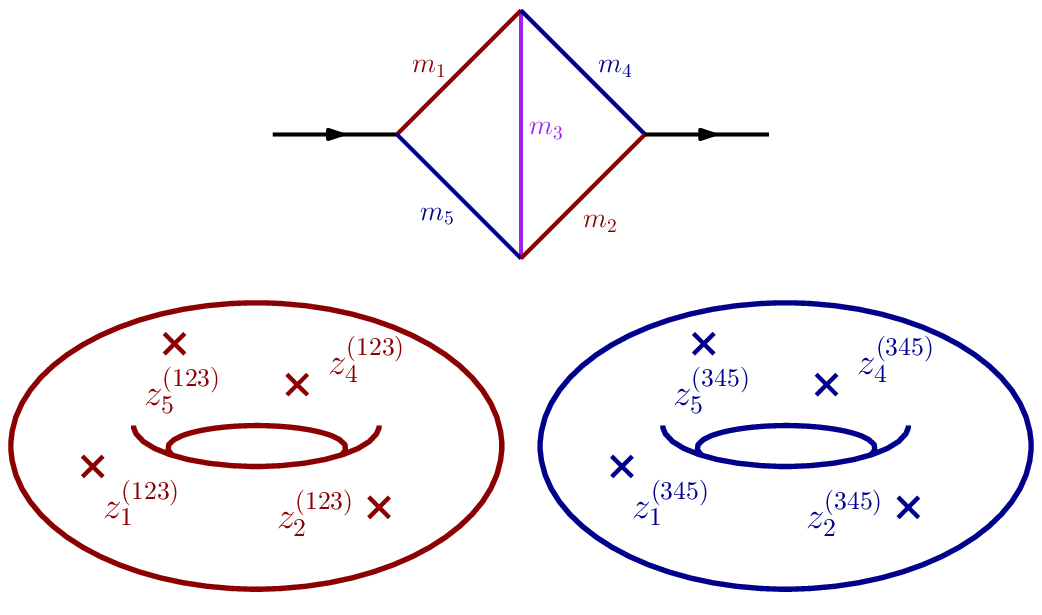
The five-mass kite and its two punctured tori
The five-mass kite and the two punctured tori whose elliptic curves it depends on (see 2401.14307).

Cosmological correlators

Correlators in power-law FRW cosmologies are relative twisted integrals. This gives a natural basis and easy differential equations; the split of the basis into physical and unphysical parts is fixed by the geometry of unitarity cuts; and kinematic flow, first found empirically, follows from the flow of cuts. A graphical coaction organizes the derivatives and discontinuities of FRW correlators; you can explore it at frwcoaction.ca.

Papers: 2308.03753 · 2411.09695 · 2508.11568 · 2503.23579 · 2603.25703 · 2606.13627

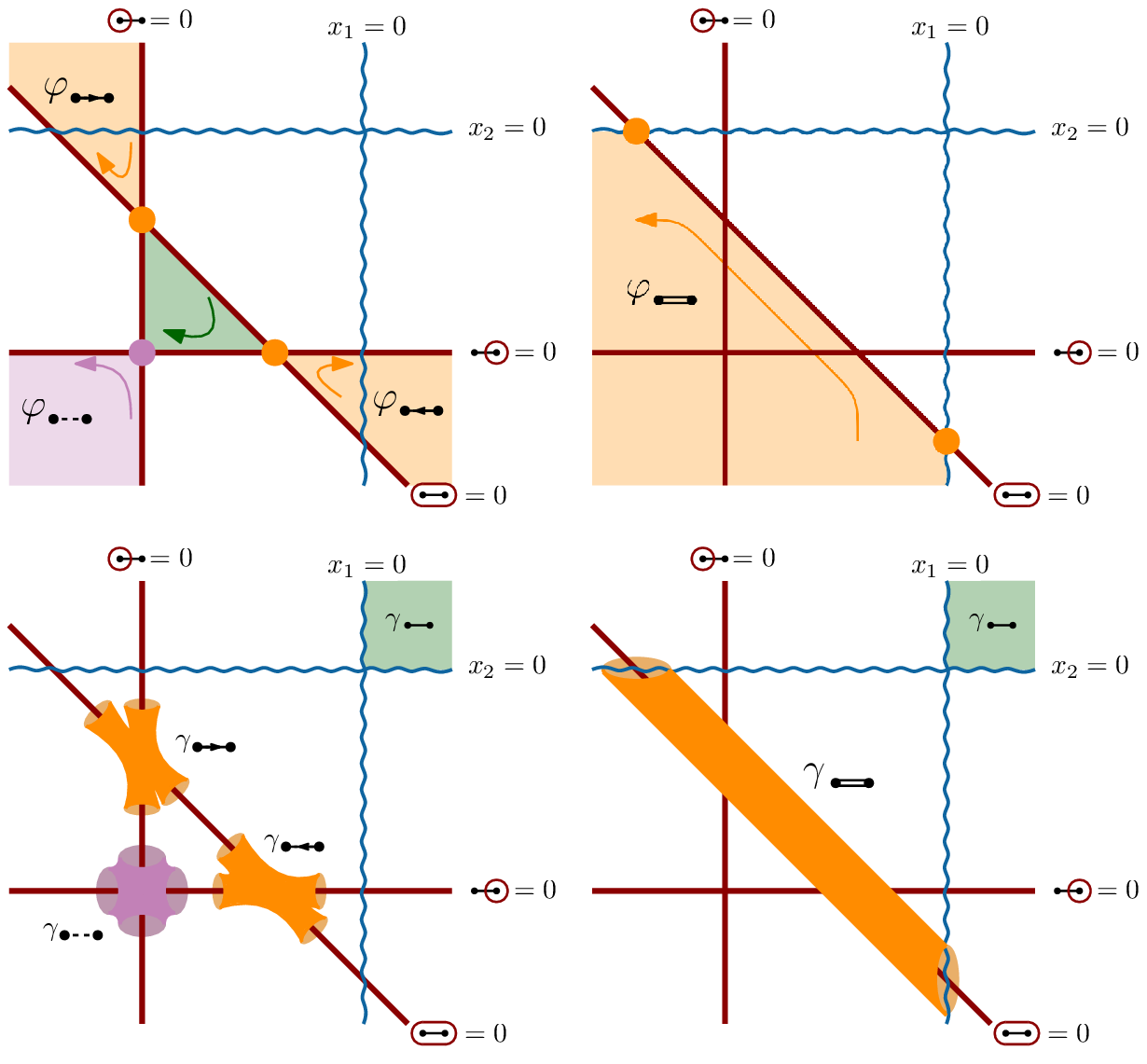
Basis forms and contours of the two-site chain drawn on its hyperplane arrangement
The two-site chain: basis forms φ (top) and contours γ (bottom), one for each decorated graph, drawn on the hyperplane arrangement (see 2606.13627).

Also

Symbol alphabets and cluster algebras in QCD (2506.11895), surfaceology for Yukawa theory (2406.04411), five-dimensional spinor helicity (2405.09533), energy correlators (2509.22782 · 2012.01406) and direct-to-symbol integration from Landau analysis (2609.15952).